

I Built Backlinks, but My Rankings Didn’t Change. How Can I Tell What’s Actually Wrong?
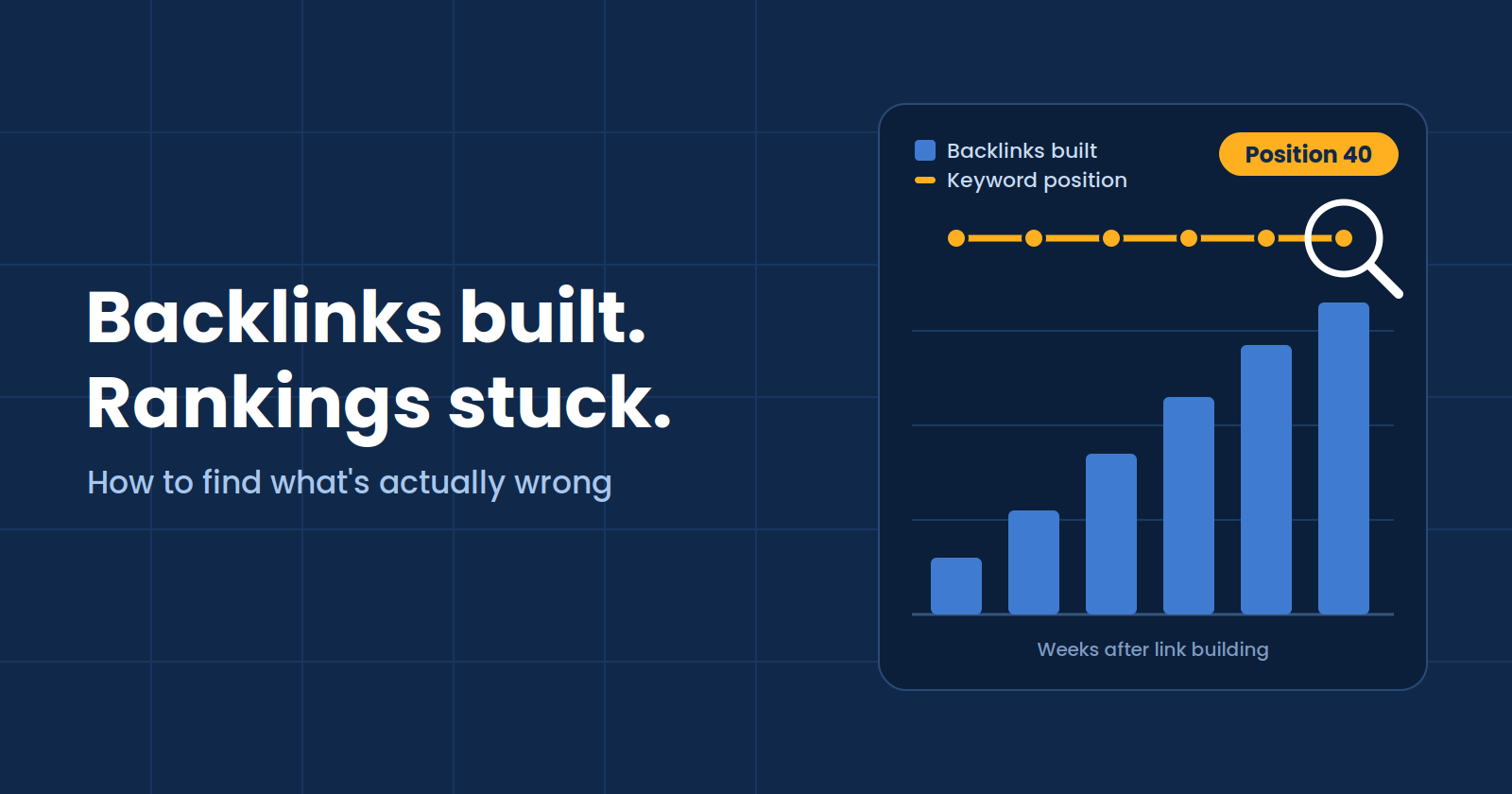
You built backlinks to your website, but your Google rankings are still the same. You checked your backlink report, and the links appear to be there. You may have even paid for a link-building service, yet your target keywords are not moving up.
So, what went wrong?
Should you build more backlinks? Improve your content? Change your target keywords? Or wait longer for Google to respond?
The problem is that you cannot answer these questions by looking at the number of backlinks alone.
A website can gain new backlinks without seeing an immediate ranking improvement. Sometimes the links are not useful enough to make a difference. Sometimes Google has not processed them yet. In other cases, the target page has a problem that backlinks cannot fix.
The good news is that you do not have to guess.
You can check your backlink report, Google Search Console, target pages, and competitors to find clues about what is happening.
In this guide, we will look at five common backlink problems, explain how to identify each one, and show you what to do next.
First, Understand What You Were Trying to Improve
Before checking your backlinks, identify the exact page and keyword you wanted to improve.
For example, imagine you run an online store selling office furniture. You want your product category page to rank for “office chairs for small spaces.”
You build 50 backlinks, but your target keyword stays around position 40.
Before ordering another 50 links, ask yourself:
Did the backlinks point to the office chair category page?
Are the referring pages relevant to office furniture or related topics?
Is the category page useful enough to compete with other results?
Was the page already ranking before the campaign?
Has enough time passed to measure a meaningful change?
These questions matter because a backlink campaign can be completed as planned without achieving the ranking improvement you expected.
Your first job is to find the reason for the lack of improvement, not to increase the number of backlinks.
1. Backlink Failure Diagnosis Matrix
Use this table to identify which problem best matches your situation.
| What you notice | What it might mean | What to check first |
|---|---|---|
| Your backlink report shows links, but the referring pages are missing or broken | Some placements may not have been delivered as expected | Open the referring URLs and verify the links |
| Your links are live, but the target keyword has not moved | The links may not provide enough competitive value, or another issue may be holding the page back | Review Search Console, page quality, and competitors |
| Your rankings improve for unrelated keywords | Your page may be attracting searches that do not match your main goal | Compare the queries with the page’s content and purpose |
| Your page ranks higher, but traffic remains low | The ranking changes may involve low-demand queries or positions that attract few clicks | Check impressions, clicks, and individual queries |
| Your rankings drop after link building | The drop may be related to another change, normal fluctuations, or a wider search update | Compare the timeline and investigate other possible causes |
These are starting points, not final answers. One symptom can have several causes.
The following sections explain how to investigate each situation.
2. Problem One: Your Backlinks Exist in the Report but May Not Be Useful
A backlink report can show 100 placements, but that does not mean all 100 links are helping your website in the way you expected.
Start by opening the actual pages where your links were placed.
Do not rely only on a spreadsheet, a delivery report, or a third-party SEO score.
Check whether the links are still there
Open a sample of the referring pages and confirm that:
The page loads correctly.
Your backlink is still present.
The link points to the correct URL.
The link is placed in visible, relevant content.
The destination page works properly.
For example, you paid for 100 backlinks, but after checking the report, you find that 18 links are missing.
Your first concern should be whether the agreed placements were delivered and remain available. Building more links before resolving that issue may lead to unnecessary spending.
If some pages are temporarily unavailable, check them again before marking the links as lost.
Check the pages where your links appear
A link from a genuine article about your industry may be more useful than a link placed on an unrelated page created mainly to host backlinks.
Look at the surrounding content.
Does the page discuss a related subject? Does the link make sense in the paragraph? Does the website appear to serve a real audience?
Also check for technical issues, such as broken links, redirects, and pages that search engines cannot crawl.
Do not judge a backlink only by Domain Authority (DA) or Domain Rating (DR). These are third-party metrics, not Google’s own scores. A high score does not guarantee that a particular link will improve your rankings.
What to do next: Make three lists: links that are confirmed live, links that need another check, and links that are missing or broken. Resolve delivery problems before deciding whether your SEO strategy needs to change.
3. Problem Two: The Links Are Live, but Your Target Page Is Not Improving
This is where you need to look beyond the backlink report.
Imagine your website has a page targeting “best accounting software for freelancers.” You build relevant backlinks, but the page remains on page three of Google.
The links may be genuine. The page may even be indexed. Yet other websites continue to rank above it.
One possible reason is that your page does not provide what searchers want.
Check what people expect to find
Search your target keyword in Google and review the pages that already rank.
Look at the type of content Google is showing.
For example, someone searching for “best accounting software for freelancers” will probably want a comparison of different options, prices, features, and advantages.
If your page only promotes one product without explaining why it is suitable, it may not answer the searcher’s main questions.
In this case, more backlinks may not solve the content problem.
Ask yourself:
Does my page answer the main question behind the keyword?
Does it include the information a reader needs?
Is the page too general for the search?
Does it offer useful details that are missing from competing pages?
Is the page trying to rank for a keyword that does not match its purpose?
You do not need to copy the pages that rank above you. Instead, understand what makes them useful and improve your own page where it falls short.
Check whether your page is indexed
A backlink cannot guarantee that Google will index your target page.
Open Google Search Console and use the URL Inspection tool to check the exact page.
If Google has not indexed it, investigate the reason. There may be a noindex directive, a canonical issue, a crawl problem, or another technical reason.
If the page is not indexed, fix the underlying issue before spending more on backlinks.
If the page is indexed, that is useful information, but it does not guarantee that the page is strong enough to rank for your chosen keyword.
What to do next: If the page is indexed but does not match search intent, improve its content and usefulness. If it is not indexed, investigate the indexing problem first.
4. Problem Three: Your Backlinks Point to the Wrong Pages
This problem is easy to miss because your website may have gained many backlinks while the page you want to rank receives very few.
For example, you want your SEO service page to rank for “ecommerce SEO services.”
You build 80 backlinks, but 70 point to your homepage and only a few point to your service page.
The campaign has added links to your website, but the distribution may not support your target page as well as you expected.
This does not mean every backlink must point directly to a service or product page. Links to your homepage and useful blog articles can also support your website.
The important question is whether your link-building plan matches your goals.
How to check your backlink destinations
Export your backlink report and review the target URL for each link.
Group the links by destination:
Homepage
Service pages
Product pages
Blog articles
Old or redirected pages
Then compare the results with the pages you want to improve.
If your main service page has few relevant backlinks, investigate whether it needs stronger internal links, better content, or suitable opportunities to earn external links.
Do not ignore internal links
Internal links connect one page of your website to another.
Suppose one of your blog articles attracts useful backlinks. You can link from that article to a related service page when the link helps the reader.
This can help users and search engines discover the related page and understand its connection to the topic.
However, adding internal links does not guarantee a ranking improvement. The links should make sense in context and help visitors find useful information.
What to do next: Identify which pages actually received your backlinks. If your target page is being overlooked, review your internal links and decide whether it needs more relevant external links.
5. Problem Four: Your Rankings Improve, but You Get Almost No Traffic
Not every backlink problem appears as a complete lack of ranking improvement.
Sometimes your rankings move up, but your website receives almost no additional visitors.
For example, a keyword moves from position 55 to position 38. That is a ranking change, but the page is still far down the search results.
It is reasonable to see little or no noticeable traffic increase.
Another possibility is that your page improves for queries that receive very few searches.
This is why checking a single ranking number is not enough.
Check Google Search Console
Open the Performance report in Google Search Console.
Select the page you are trying to improve and review:
Impressions: How often the page appeared in Google Search.
Clicks: How many clicks the page received.
Average position: The average position of your search results across the selected data.
Queries: The actual searches that brought your page into the results.
Compare the data before and after your link-building campaign.
For example, you might find that impressions have increased, but the page is appearing for searches that are not closely related to your main keyword.
That tells you something important: your page is gaining visibility, but the new visibility may not be reaching the audience you want.
Alternatively, the page may be ranking better for your main keyword, but its position is still too low to attract many clicks.
Check whether the keyword is worth targeting
A keyword may look attractive because it has a high estimated search volume in an SEO tool.
But the actual demand may be lower, or the search results may not match your business goals.
Look at the queries your page receives and determine whether they are relevant to your audience.
Also remember that Search Console’s average position is not a fixed ranking for every search. It combines results across different queries and situations.
What to do next: Find out which queries are improving, whether they are relevant, and whether the changes are generating useful traffic. Do not judge the entire campaign by one keyword alone.
6. Problem Five: Your Competitors Are Still Stronger Than You
You may have live backlinks, useful content, and a properly indexed page. Yet your rankings remain unchanged.
One possible explanation is that the competing pages have advantages your website has not matched.
For example, you build 30 backlinks to a page about email marketing software. A competitor has fewer backlinks overall but has earned relevant links from established marketing publications and offers a detailed comparison that answers the searcher’s questions.
Counting backlinks alone will not explain why the competitor ranks higher.
Compare the pages, not just the domains
Review the pages competing for your target keyword.
Look at the following:
Links to the actual ranking pages: How many relevant websites link directly to the competing pages? How does this compare with your target page?
Content quality: Do the competing pages explain the subject more clearly or offer more useful details?
Search intent: Are they providing the type of content people expect to find?
Website structure: Are their important pages easy to find through internal links?
Useful experience: Do they provide original examples, product details, demonstrations, or other information that helps the reader?
Brand recognition: Are they established names that people already know and search for?
These factors do not prove that any single advantage caused the ranking difference. They help you understand the full competition instead of focusing only on backlink totals.
Avoid copying every competitor backlink
A competitor backlink report may reveal opportunities, but not every link is worth pursuing.
Some links may be unrelated, low quality, or placed in content that exists mainly to manipulate rankings.
Focus on relevant websites where your content could genuinely help readers.
For example, a software company might earn a useful link by publishing an original comparison, sharing research, or contributing expert information to a relevant industry publication.
The goal is not to match every competitor link. It is to improve your page and earn links that make sense for your business.
What to do next: Identify the two or three biggest gaps between your page and the pages ranking above it. Work on those gaps before expanding your backlink campaign.
7. What If Your Rankings Dropped After Building Backlinks?
A ranking drop after link building can be worrying.
You might immediately assume that the new backlinks caused the problem.
But the timing alone does not prove that they were responsible.
Your rankings may have changed because of a search-system update, a technical change on your website, stronger competitors, or normal fluctuations in search results.
You need to investigate what changed and when.
Build a simple timeline
Write down:
When your link-building campaign started.
When the new links appeared.
When your rankings began to fall.
Whether you changed your website, content, or URLs around the same time.
Whether Google announced a relevant search ranking update.
Then check whether the drop affects one page or many pages.
If one page loses rankings, start by reviewing that page and its competitors.
If many unrelated pages decline around the same time, investigate wider technical issues and possible changes affecting the whole website.
Check for manual actions
Open the Manual Actions report in Google Search Console.
If Google has issued a manual action, the report can help explain the issue.
However, the absence of a manual action does not prove that every backlink is being treated as a positive ranking signal.
Google’s systems can handle many kinds of spam without issuing a manual action.
Should you disavow the backlinks?
Do not disavow links just because your rankings have not improved or because a third-party tool labels them toxic.
Google says most websites do not need to use the disavow tool.
Consider it only when there is a clear reason, such as a substantial pattern of artificial links created to manipulate rankings that has resulted in, or is likely to result in, a manual action.
First investigate the evidence. Removing or disavowing links without a clear reason can waste time and may cause you to discard legitimate links.
What to do next: Find out whether the drop is limited to specific pages or affects the wider website. Investigate the timeline before blaming the backlink campaign.
8. How to Tell Whether You Should Build More Backlinks
After checking your website, you may still be unsure whether to continue link building.
Use the evidence you collected to make that decision.
| Your findings | What you should do |
|---|---|
| Many reported links are missing | Verify the placements and resolve delivery issues |
| The target page is not indexed | Investigate the indexing problem |
| Your page does not satisfy search intent | Improve the content before expanding the campaign |
| Most links point to unrelated or low-value pages | Review the campaign and focus on relevant opportunities |
| Competitors have stronger pages and useful links | Improve your page and investigate legitimate link opportunities |
| Rankings improve for irrelevant searches | Review the page’s focus and keyword targeting |
| Rankings improve but traffic remains low | Check query demand, search intent, and actual positions |
| Your links are live and the page is competitive, but results are unchanged | Continue monitoring and review other possible ranking factors before deciding on further investment |
The key is to avoid repeating the same action without knowing whether it addresses the problem.
If the target page is weak, more backlinks may not fix it. If the links were not delivered as agreed, publishing more content will not resolve the delivery issue.
Choose your next step based on what you actually found.
9. A Simple 30-Day Plan to Find the Problem
You do not need to change your entire SEO strategy in one day.
Use the following plan to organize your investigation.
Week 1: Check the backlinks
Review your backlink report and open a sample of the referring pages.
Confirm which links are live, which need another check, and which are missing. Check the destination URLs and look for obvious technical problems.
Your goal: Find out what your campaign actually delivered.
Week 2: Check the target page
Use Google Search Console to inspect the page’s indexing status and review its search performance.
Check internal links, canonical tags, redirects, and other technical issues where relevant.
Your goal: Make sure the page can be found and understood by search engines.
Week 3: Study the competition
Search your main keywords and compare your page with the pages that rank above it.
Look for differences in search intent, useful information, page structure, and relevant backlinks.
Your goal: Identify the most important weaknesses in your page.
Week 4: Fix the main problems
Address the issues you found during the first three weeks.
This may involve correcting broken placements, improving content, fixing technical problems, strengthening internal links, or identifying suitable websites from which to earn relevant backlinks.
Record the changes so you can compare performance later.
Your goal: Fix the most likely problems before spending more on link building.
Thirty days is enough to organize a useful investigation, but it is not a guaranteed period for ranking improvements. Some changes take longer to be reflected in search results.
10. What Information Should You Record During Your Investigation?
One reason SEO campaigns become difficult to evaluate is that people forget what changed and when.
A simple tracking sheet can help you avoid this problem.
Record the following information:
| Item | What to record |
|---|---|
| Target page | The exact URL you wanted to improve |
| Target keyword | The main query you are monitoring |
| Campaign date | When the backlink campaign started |
| Links delivered | The number reported by the provider |
| Links verified | The number you manually confirmed |
| Starting performance | Baseline impressions, clicks, and average position |
| Current performance | The same metrics for a comparable period |
| Other changes | Content updates, technical fixes, or website changes |
| Main finding | The most likely problem based on the available evidence |
| Next action | What you plan to fix or investigate |
Keep the tracking sheet focused on your important pages and keywords.
You do not need to monitor every URL on your website to understand why a particular campaign has not produced the expected result.
Over time, this record will also help you understand which types of changes are associated with better results on your website.
Frequently Asked Questions
Why are my backlinks not improving rankings?
There is no single explanation. Your links may not provide enough competitive value, your target page may need improvement, or Google may not have processed the changes yet. Check the backlinks, target page, and competing results before deciding what to fix.
How long should I wait before judging a backlink campaign?
There is no fixed waiting period that guarantees a result. Monitor your target pages over several weeks and longer where necessary. Compare similar periods and consider other changes that may affect rankings.
Can 100 backlinks fail to improve rankings?
Yes. A large number of backlinks does not guarantee better rankings. Their relevance, quality, placement, destination, and overall context matter, along with the strength of your page and its competitors.
How do I know if Google has found my backlinks?
You can inspect the referring pages and use available SEO tools to check their status. However, no public report provides a complete list of every backlink Google has discovered and processed. A link appearing in a third-party tool does not prove that Google has counted it as a ranking signal.
Should I build more backlinks if my rankings have not changed?
Not before checking the existing campaign. First investigate whether the links are live, whether they point to the right pages, and whether your content and technical SEO are competitive. Build more links only when they are an appropriate part of your next step.
Can good backlinks improve rankings without increasing traffic?
Yes. Rankings may improve for searches with little demand, or your page may still rank too low to attract many clicks. Use Google Search Console to see which queries are improving and whether the changes bring relevant visitors.
Final Thoughts
Building backlinks without seeing a ranking improvement does not automatically mean your campaign has failed. It also does not mean you should continue building links until something changes.
Start with the evidence.
Check whether the links are live, whether they point to the right pages, and whether your target pages are indexed. Then investigate search intent, content quality, competitors, and any wider changes affecting your website.
You may discover that some placements need to be corrected. You may find that your content needs improvement before additional links will be useful. Or you may find that the campaign needs more time before its impact can be assessed.
The important thing is to understand the problem before spending more money trying to solve it.
At Komtech, we approach SEO by looking at the actual issues affecting a website, from backlink quality and on-page SEO to technical problems and competitor gaps. The goal is to identify what needs attention first, rather than recommending more backlinks without understanding why rankings have stalled.