

Seller Central Management: How Professional Amazon Seller Management Services Work
Managing an Amazon account is not just about completing individual tasks. Once a seller has an active business, someone needs to keep track of what is happening inside the account, organize ongoing work, identify problems, and make sure important matters reach the right person.
That is where Seller Central management comes in.
Professional Amazon seller management services provide ongoing support for the administration and coordination of an Amazon account. Instead of the business owner having to remember every task, notification, request, and follow-up, a dedicated management process keeps the work organized.
The exact responsibilities can vary from one business to another. A small account may need limited administrative support, while a larger seller may require a structured management system involving several people.
What Is Seller Central Management?
Seller Central management is the ongoing process of overseeing an Amazon seller account and coordinating the work required to keep the account properly managed.
The important distinction is between doing a particular Amazon task and managing the account as an ongoing operation.
A seller may have different people responsible for different areas. Someone may handle advertising, another person may handle customer communication, and the business owner may make purchasing decisions.
Seller Central management helps keep these responsibilities organized.
A management process can involve:
- Monitoring the account regularly
- Reviewing new notifications and requests
- Maintaining a list of open issues
- Assigning tasks to the appropriate person
- Following up on unfinished work
- Escalating important problems
- Recording decisions and actions
- Preparing regular updates
- Keeping communication between the seller and management team organized
The purpose is to create account oversight, rather than simply increasing the number of tasks being performed.
What Does an Amazon Seller Manager Do?
An Amazon seller manager is essentially a coordinator for the account’s ongoing activities.
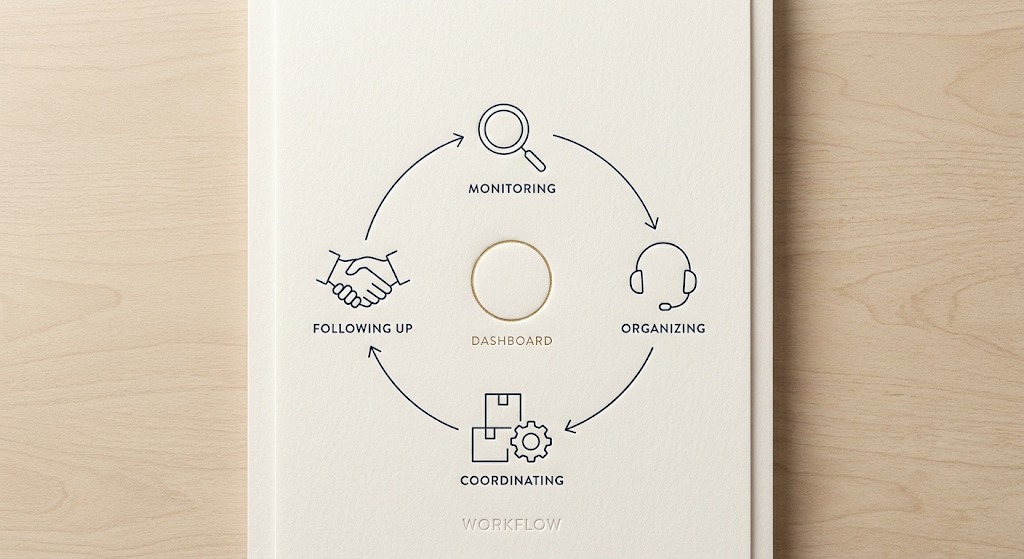
Their job depends on the agreement with the seller, but the role can involve four main responsibilities:
1. Monitor
The manager keeps an eye on the account and identifies new matters that require attention.
2. Organize
New tasks and problems are categorized so the team knows what needs to happen next.
3. Coordinate
When another person needs to take action, the manager makes sure the task reaches the correct person.
4. Follow Up
An issue should not simply be assigned and forgotten. The manager follows its progress until it is completed, resolved, or escalated.
This creates a continuous management cycle rather than a collection of disconnected tasks.
How a Seller Central Management Workflow Works
A professional management process can follow a simple workflow.
Step 1: Monitor the Account
The account is checked according to an agreed schedule.
The purpose is to identify new notifications, changes, requests, and issues.
Step 2: Identify What Requires Attention
Not every message or change deserves the same response.
The manager determines whether something is:
- Informational
- Routine
- Time-sensitive
- Urgent
- Dependent on seller approval
- Suitable for escalation
Step 3: Record the Issue
Important matters should be recorded rather than kept only in someone’s memory.
A basic record can include:
- Date identified
- Issue
- Account area involved
- Current status
- Person responsible
- Required action
- Deadline, if applicable
- Latest update
Step 4: Assign the Work
If another team member needs to act, responsibility should be clearly assigned.
This prevents situations where everyone assumes someone else is handling the issue.
Step 5: Follow Up
The manager checks whether the required action has actually been completed.
Step 6: Close or Escalate
Once resolved, the matter can be marked complete.
If it cannot be resolved through normal account management, it should be escalated to the seller or an appropriate specialist.
This process is one of the main differences between casual account assistance and structured account management.
Prioritizing Amazon Account Issues
One of the biggest challenges in managing an active Seller Central account is deciding what deserves attention first.
A useful priority system can divide issues into categories.
Urgent Issues
These require immediate attention because delaying them could create a larger problem.
Time-Sensitive Issues
These may have a response deadline or require action within a specific period.
Routine Tasks
These can be handled as part of the normal management schedule.
Monitoring Items
These do not require immediate action but should remain on the team’s radar.
This approach prevents the management team from treating every notification as equally important.
Keeping an Amazon Issue Log
An issue log can be one of the simplest ways to improve account organization.
Instead of relying on emails, messages, or memory, important matters can be recorded in one place.
For example:
Issue | Priority | Owner | Status | Next Action |
Account notification | High | Manager | Open | Review details |
Seller approval required | Medium | Owner | Waiting | Owner decision |
Routine request | Low | Assistant | In progress | Follow up |
Amazon response pending | Medium | Manager | Waiting | Check status |
The exact format can be changed according to the business.
The important part is that open matters remain visible until they are completed.
Seller Approval and Decision Making
An external management team should not automatically make every decision for the seller.
Some matters require the owner’s approval because they affect the business financially, legally, operationally, or strategically.
A clear management system should therefore distinguish between:
Tasks the manager can handle independently
and
Decisions that require seller approval.
For example, a manager may identify an issue, collect the relevant information, and explain the available options.
The business owner can then make the final decision.
This creates a clear separation between account administration and business ownership.
Amazon Seller Central Communication
Communication becomes increasingly important when an external team is managing an account.
Without a clear communication process, even simple issues can become confusing.
A good arrangement should establish:
- Who the main contact is
- Where routine updates are sent
- How urgent matters are communicated
- What requires immediate seller approval
- How completed work is reported
- How questions are documented
- How unresolved matters are followed up
This avoids having important account information spread across different conversations.
A Simple Communication Structure
A management team can use a regular update containing:
Completed:
Tasks handled since the previous update.
Open:
Issues that are still being worked on.
Waiting:
Items requiring Amazon, another team member, or the seller.
Action Required:
Decisions that need approval from the business owner.
Notes:
Other account developments worth knowing.
This gives the seller a quick understanding of the account without requiring them to inspect every activity themselves.
Managing Seller Central Access
Account access should be treated as part of the management process.
If several people work on an Amazon account, giving everyone unrestricted access can make it difficult to control who can perform certain actions.
A better approach is to consider what each person actually needs to do.
For example, someone responsible for a limited administrative function may not need the same level of access as the account owner.
A management provider should therefore work with the seller to establish appropriate access for each role.
The seller should retain control over the primary account and sensitive permissions.
Managing Multiple People on One Amazon Account
Amazon businesses can involve owners, employees, virtual assistants, agencies, customer-service staff, and other contractors.
The larger the team becomes, the easier it is for responsibilities to overlap.
A management structure can define:
- Who is responsible for monitoring
- Who handles routine tasks
- Who investigates issues
- Who communicates with the seller
- Who can make changes
- Who needs approval
- Who handles escalations
This reduces the chance of two people doing the same work while another task is completely overlooked.
Creating Standard Operating Procedures for Amazon Management
A growing Amazon business should not depend entirely on one person’s memory.
Standard operating procedures, or SOPs, can document how recurring account-management tasks should be handled.
An SOP might explain:
- Where to look for new issues
- What information to record
- How to determine priority
- Who should receive the task
- When to notify the seller
- How to document the action taken
- When the issue can be marked complete
- When it should be escalated
This becomes particularly valuable when a new employee or contractor joins the team.
Instead of explaining the same process repeatedly, the business has a documented workflow.
Amazon Seller Management During Staff Changes
A common problem for growing businesses is depending too heavily on one person who knows how the account is managed.
If that person becomes unavailable, important knowledge can disappear with them.
A documented management system makes the transition easier.
The business can maintain:
- Current responsibilities
- Open issues
- Account procedures
- Communication instructions
- Access information
- SOPs
- Escalation procedures
- Reporting formats
This gives another team member a clearer starting point.
What Happens When an Amazon Issue Cannot Be Resolved Normally?
Not every Seller Central issue can be solved by routine account management.
Some matters may require:
- Additional documentation
- Seller approval
- A specialized response
- Communication with Amazon
- Technical investigation
- Legal or compliance advice
- Input from another service provider
A professional manager should recognize the boundary of their responsibility.
Instead of promising that every issue can be solved internally, the manager can document the situation, gather relevant information, and escalate it appropriately.
Knowing when to escalate is an important part of effective account management.
Amazon Seller Management Reporting
The seller should know what is happening without having to ask for an update every time.
Reporting can be simple and practical.
A regular report might include:
Account Activity
Important changes or developments identified during the reporting period.
Open Issues
Problems that remain unresolved.
Completed Work
Tasks that have been completed.
Pending Decisions
Items waiting for approval from the business owner.
Escalated Matters
Issues that require additional attention or specialist involvement.
Upcoming Actions
Tasks expected to be handled next.
The goal is not to produce reports simply for the sake of reporting.
The goal is to give the owner visibility and control while someone else handles the day-to-day management.
Daily, Weekly, and Monthly Management
The management schedule can be divided according to the type of work.
Daily
Daily management can focus on:
- New notifications
- New issues
- Urgent matters
- Open tasks
- Seller requests
- Items approaching deadlines
Weekly
Weekly management can focus on:
- Outstanding issues
- Repeated problems
- Completed work
- Pending seller decisions
- Team responsibilities
- Account-management patterns
Monthly
Monthly reviews can focus on:
- Recurring account issues
- Management workload
- Process improvements
- Team responsibilities
- Open matters that have remained unresolved
- Whether the current management arrangement still fits the business
This creates different levels of oversight instead of treating every task as a daily emergency.
When Does an Amazon Seller Need Management Support?
A seller may start considering professional management when account administration begins consuming too much time.
Some common signs include:
- Checking Seller Central has become a daily burden
- Important matters are being discovered late
- There are too many open tasks to track manually
- Several people are working on the account
- Nobody has clear responsibility for follow-ups
- The owner spends time coordinating people instead of running the business
- Account issues are being handled reactively
- There is no documented workflow
- The business owner wants regular visibility without managing every task personally
The number of products alone does not determine whether management support is necessary.
The more important question is:
How difficult has the account become to manage consistently?
In-House vs. Outsourced Amazon Seller Management
A business can manage its Seller Central account internally or work with an external provider.
In-House Management
An internal employee can become familiar with the business and work closely with other departments.
However, the business is responsible for recruitment, training, supervision, holidays, staff turnover, and maintaining the required knowledge.
Outsourced Management
An external provider can take responsibility for an agreed set of management activities.
This can be useful when the business wants ongoing support without building a dedicated internal management team.
Neither approach is automatically right for every seller.
The important consideration is whether the chosen setup provides consistent oversight and clear responsibility.
What Should Be Included in Amazon Seller Management Services?
There is no universal package that every seller needs.
A professional Amazon seller management service should clearly define its scope before work begins.
Depending on the account, the service may include:
- Seller Central monitoring
- Account administration
- Issue tracking
- Task coordination
- Notification monitoring
- Follow-up management
- Seller communication
- Reporting
- Access coordination
- SOP development
- Escalation management
- Ongoing account oversight
Other Amazon services can remain with separate specialists if the seller prefers.
This means a business does not necessarily need to outsource its entire Amazon operation just to receive Seller Central management support.
Questions to Ask Before Hiring an Amazon Seller Management Service
Before hiring a provider, ask practical questions.
Who will actually manage the account?
You should know whether the work is handled by one dedicated person, a team, or a rotating group.
How often will the account be monitored?
The answer should match the activity level and requirements of the account.
How are issues tracked?
Ask whether there is a defined system for open tasks and follow-ups.
What requires my approval?
This should be agreed before work begins.
How will urgent issues be communicated?
You should know what happens when something cannot wait until the next regular report.
What will I receive each week or month?
Ask for examples of the reporting format and information provided.
How is account access handled?
The provider should explain how access is granted and how permissions are managed.
What happens when something is outside your scope?
A good provider should have a clear escalation process rather than simply promising to handle everything.
Common Amazon Account Management Problems
Poor management is often caused by process problems rather than a lack of Amazon knowledge.
No Clear Owner
If everyone is responsible, nobody may actually be responsible.
No Follow-Up System
An issue can easily be forgotten after the initial action.
Too Much Communication
Important information can become difficult to find when every small matter is sent through separate messages.
No Priority System
Treating every task as urgent makes it difficult to focus on matters that actually require immediate attention.
Poor Documentation
Without records, the team may not know what was previously done.
Excessive Access
Giving more account access than necessary increases administrative risk.
No Escalation Rules
The team may waste time trying to solve something that should have been passed to the seller or a specialist.
No Regular Reporting
The business owner may have little visibility into what is happening until a problem becomes noticeable.
How to Tell Whether Management Is Working
The value of Amazon seller management should not be measured simply by how many hours someone spends inside Seller Central.
Look at the management process itself.
Are important matters being identified?
Are open issues being tracked?
Are responsibilities clear?
Are seller decisions reaching the right person?
Are completed tasks documented?
Are recurring problems being noticed?
Does the business owner know what requires attention without having to investigate everything personally?
These are better indicators of an organized management system than simply counting activities.
How Komtech Can Support Seller Central Management
At Komtech, our Amazon seller management services can be structured around the management requirements of an existing Amazon account.
Instead of assuming that every seller needs the same package, we can define the areas that require ongoing support and establish a clear workflow around them.
This can include account monitoring, task coordination, issue tracking, follow-ups, communication, reporting, and escalation where appropriate.
The seller remains involved in important business decisions while the management side stays organized and consistently monitored.
For businesses that already have separate people handling areas such as advertising, content, or other Amazon activities, management support can also be structured around those existing teams.
Frequently Asked Questions
What is Seller Central management?
Seller Central management is the ongoing process of monitoring, organizing, coordinating, and following up on activities related to an Amazon seller account.
What does an Amazon seller manager do?
An Amazon seller manager monitors the account, identifies issues, organizes tasks, coordinates responsible team members, follows up on open matters, and keeps the seller informed.
What are Amazon seller management services?
Amazon seller management services provide ongoing support for the administration and coordination of an Amazon seller account. The exact scope depends on the seller’s requirements.
Can I outsource Seller Central management without outsourcing my entire Amazon business?
Yes. Seller Central management can be handled separately from other Amazon services. A seller can retain specialists for particular areas while outsourcing account administration and coordination.
How often should an Amazon account be monitored?
The appropriate frequency depends on the account’s activity and requirements. Active accounts may require more frequent monitoring than smaller accounts.
Does an Amazon seller manager make business decisions for me?
Not necessarily. Important commercial or account decisions can remain with the business owner. The manager can identify the issue, organize the information, and request approval when necessary.
How should Amazon account issues be tracked?
A simple issue log can record the problem, priority, responsible person, current status, required action, and next follow-up.
Is Amazon seller management suitable for small sellers?
It can be, but not every small seller needs external management. The deciding factor is usually the amount of ongoing administration and whether the owner has enough time to handle it consistently.
What should I expect from an Amazon management company?
You should expect clearly defined responsibilities, an agreed communication process, appropriate account access, regular monitoring, issue tracking, follow-ups, and reporting.
What happens if an Amazon issue requires specialist help?
The management team should identify that the issue falls outside routine management, gather the necessary information, and escalate it to the seller or an appropriate specialist.
Final Thoughts
Effective Seller Central management is less about performing every Amazon task and more about keeping the account organized and making sure nothing important is overlooked.
A structured process gives every issue an owner, every important task a follow-up, and every major decision a clear path to the business owner.
For sellers who are spending too much time monitoring their account or coordinating multiple people, professional Amazon seller management services can take responsibility for that ongoing administrative workload.
The right setup depends on the seller’s account, internal team, workload, and preferred level of involvement. What matters most is having clear responsibilities, consistent monitoring, organized communication, and a reliable process for dealing with issues as they arise.