

Why Amazon Sellers Can Have High Sales but Low Profits
Your Amazon store made $50,000 in sales last month. Sounds like a good month, right?
But after paying Amazon fees, suppliers, advertising costs, shipping, and other expenses, you check your account and realize there is not much money left.
So, where did it all go?
This is a problem Amazon sellers can face even when their products are selling well. More orders do not always mean more money in your pocket. Sometimes, the store is making sales, but the costs of getting those sales are eating up most of the earnings.
If you sell on Amazon in the US, understanding your costs is just as important as finding products that people want to buy. This guide explains why profits can stay low even when sales are high, what to check in your store, and how to make better decisions.
The examples below use estimated figures to explain how costs work. Your actual results will depend on your products, fees, advertising, and business expenses.
1. High Sales Do Not Always Mean High Profit
Sales show how much money customers spend on your products. Profit shows how much you keep after paying your costs.
For example, imagine your store makes $30,000 in sales. You spend $9,000 on products, $7,500 on Amazon fees, $5,000 on ads, and $5,000 on other costs. You are left with $3,500 before any additional expenses not included in these figures.
That may be much less than you expected from $30,000 in sales.
It helps to understand three basic terms:
- Gross profit: Sales minus the cost of the products sold.
- Contribution profit: What remains after product costs and the direct costs of selling those products, such as Amazon fees and advertising, based on the costs included in your calculation.
- Net profit: What remains after all business expenses have been paid.
A product can look profitable when you compare its selling price with its purchase cost. But once you include Amazon fees, ads, shipping, and returns, the result may be very different.
That is why it is important to look beyond the total sales figure.
2. Amazon Fees Can Take a Big Share of Your Sales
Selling on Amazon gives you access to a large customer base, but using the marketplace comes with costs. Depending on your products and how you fulfill orders, you may pay:
- Selling plan fees
- Referral fees
- Fulfillment by Amazon (FBA) fees
- Monthly storage fees
- Fees for aged inventory, removal, or disposal, where applicable
- Other fees related to your account or products
Not every seller pays the same fees. Charges can depend on the product category, size, weight, selling plan, and fulfillment method.
Let’s say you sell a product for $25. The selling price may look good, but after Amazon’s fees and the cost of the product, your remaining margin could be quite small. Advertising and shipping expenses can reduce it even further.
Before launching a product or changing its price, calculate the costs that apply to that product.
You can review Amazon’s selling plans and pricing for details about its main fees. The Amazon Revenue Calculator can also help you estimate costs and compare fulfillment methods for eligible products.
Use these tools as a starting point, then include your own supplier, shipping, advertising, and other expenses.
3. Advertising Costs Can Eat Into Your Profit
Amazon ads can help your products reach more shoppers. But if you spend too much to generate sales, your store may earn very little from each order.
Imagine a product generates $8,000 in sales from advertising, and you spend $2,000 on those ads. Your Advertising Cost of Sales (ACoS) is 25%.
Is that good or bad? It depends on your product’s profit margin.
If you have only a 20% margin before advertising, spending 25% of your ad sales on ads could mean you are losing money on those sales once other costs are included. If your margin is higher, the same advertising cost may be manageable.
This is why one ACoS target will not work for every product.
When checking your campaigns, look at:
- Which products can afford their current advertising costs?
- Are you spending money on search terms that rarely lead to sales?
- Are your bids too high for the profit you make per order?
- Are your campaigns helping you grow, or just adding costs without enough return?
You can also track Total Advertising Cost of Sales (TACoS), which compares advertising spend with your total sales rather than only sales attributed to ads.
Do not stop every campaign just because its ACoS looks high. Some campaigns may help a new product get noticed or support longer-term growth. The key is to understand what each campaign is doing and whether the cost makes sense for your business.
4. Your Product May Cost More Than You Think
A product can sell well and still bring in little profit if it costs too much to source and deliver.
The supplier’s unit price is only one part of the total cost. Depending on your setup, you may also pay for:
- Product samples and inspections
- Packaging and labeling
- Shipping from the supplier
- Customs duties and other import costs, where applicable
- Preparation and transportation to an Amazon fulfillment center
For example, a supplier may quote $5 per unit. By the time the product reaches the point where it is ready to sell, your actual cost may be higher.
If you calculate profit using only the original supplier price, you could end up expecting more profit than the product can deliver.
Look at the full cost of getting each unit ready for sale. You may be able to improve your margin by negotiating with suppliers, reducing shipping costs, or improving packaging.
However, the cheapest supplier is not always the best choice. Poor quality or late shipments can lead to returns, bad customer experiences, and extra costs. Any savings should be weighed against these risks.
5. Returns and Refunds Can Reduce Your Earnings
Not every order ends as a successful sale. Customers may return products, request refunds, or report damaged items.
The cost to your business depends on what happens next. Some returned products can be sold again, while others may need repackaging, removal, or disposal. You may also face lost revenue and other costs related to the return.
For example, a product may appear to have a healthy margin when you first sell it. But if many customers return it, your actual earnings could be much lower.
Start by checking your return data for patterns.
Are customers saying the product is smaller than expected? Are they reporting quality problems? Is the listing unclear about what is included? Are products arriving damaged?
These details can help you find problems worth fixing. Better product descriptions, clearer images, improved packaging, or stronger quality checks may help reduce avoidable returns.
Keep in mind that not every return can be prevented, and not every returned item is a total loss. Track what happens to returned stock so you can understand its real effect on your business.
6. Discounts and Price Cuts Can Leave You With Less Money
Lower prices can help attract customers, but they can also cut into your profit.
Suppose you sell a product for $30 and keep $6 in contribution profit per unit after the costs you have included. If you lower the price to $27 and your other costs stay the same, that $3 discount cuts your contribution profit in half.
The effect may be even greater if some of your fees or advertising costs change with the selling price.
Discounts can be useful when you want to clear stock or increase demand. The problem is lowering prices without knowing how much profit you are giving up.
Before running a promotion, calculate what you will earn per sale at the new price. Then consider whether the extra sales are likely to make up for the lower profit on each unit.
Competitor prices matter, but you do not always need to match the lowest price. Your product quality, customer reviews, demand, and costs also affect what price makes sense.
7. Poor Inventory Planning Can Tie Up Your Money
Inventory problems can hurt your business in two ways.
If you order too much stock, you may end up paying storage costs while products sit unsold. The money tied up in that inventory is also money you cannot use for other business needs.
If you order too little, your product may run out of stock. You could lose sales while waiting for the next shipment, and a rush order may cost more than planned.
Imagine that one product sells very well during a particular month. You place a large order because you expect sales to continue at the same pace. But demand slows, leaving you with more stock than you can sell quickly.
This is why inventory decisions should be based on sales history, supplier lead times, seasonal changes, and current stock levels, not just one strong month.
Check which products are moving slowly and whether they are still worth keeping in stock. For future orders, use realistic sales estimates and allow for changes in demand.
8. Some Best-Selling Products May Not Be Your Most Profitable
A product can generate a large share of your store’s sales without bringing in much profit.
For example, one product may sell hundreds of units but require heavy advertising and have high fulfillment costs. Another may sell fewer units but leave you with more money per sale.
To compare products fairly, look at the costs associated with each one, including:
- Product and shipping costs
- Amazon selling and fulfillment fees
- Advertising spend
- Discounts
- Returns and other variable expenses
Then compare the amount each product contributes to the business, not just its sales volume.
Do not rush to remove every product with a low margin. Some products may support other items in your catalog or help attract customers. First, check whether you can improve the price, reduce costs, or change your advertising approach.
The goal is to understand which products are helping your business and which ones need attention.
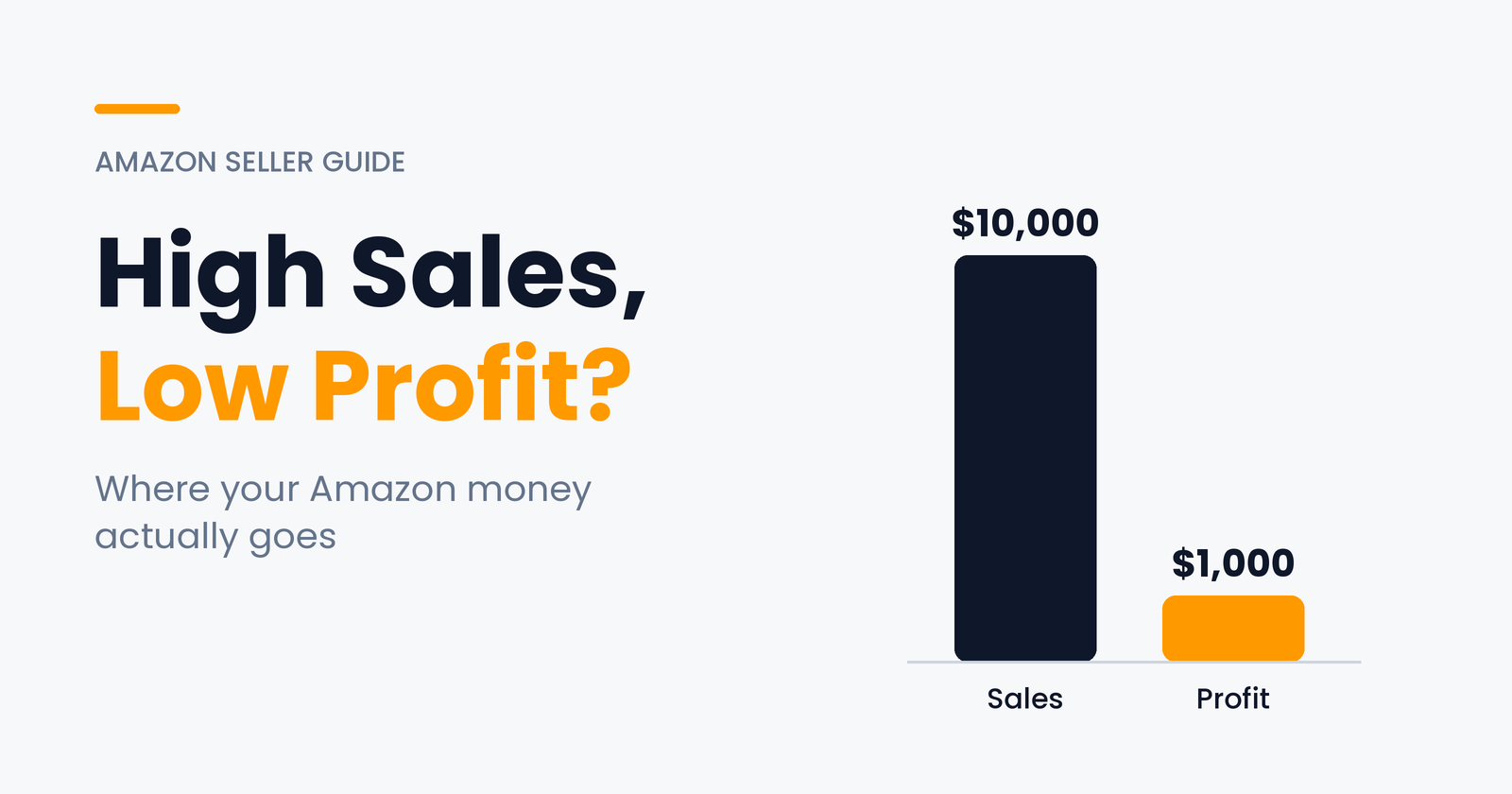
9. Example: What Happens to $10,000 in Amazon Sales?
Here is a simple example of how a store’s sales can turn into a much smaller profit.
These figures are for illustration only. They are not average Amazon fees or a prediction of what your store will earn.
Item | Amount |
Monthly sales | $10,000 |
Product costs | -$3,000 |
Amazon selling and fulfillment fees | -$2,500 |
Advertising spend | -$1,500 |
Inbound shipping and preparation | -$600 |
Returns and other variable costs | -$400 |
Money left after these costs | $2,000 |
Other operating expenses | -$1,000 |
Estimated profit before tax | $1,000 |
In this example, the seller keeps $1,000 from $10,000 in sales before tax. That is a 10% profit margin.
Your numbers may be very different. A small, lightweight product may have a different cost structure from a large, heavy item. A store that gets more sales without ads may also have different expenses from one that relies heavily on paid traffic.
Use your own figures to build a similar breakdown. Include the costs that apply to your business, and make sure you do not count the same expense twice.
Also, remember that cash flow and profit are different. You may have money tied up in inventory or waiting to be paid out even when your business is profitable on paper.
10. How to Improve Your Amazon Profit Margins
Once you understand where your money is going, you can focus on the changes that are most likely to help.
Calculate your costs before launching a product
Before placing a large order, estimate your selling price, product cost, Amazon fees, shipping, and expected advertising expenses. Add other costs that apply to your business.
Amazon’s Revenue Calculator is a useful starting point, but it will not replace your own full cost calculation.
Review your ad campaigns
Find campaigns and search terms that spend money without bringing enough sales. Adjust bids and budgets where needed, but consider the purpose of each campaign before stopping it.
Look for better sourcing and shipping options
Review supplier prices, shipping arrangements, and packaging costs. Even small savings can add up when you sell many units, as long as quality does not suffer.
Check your returns
Look for common reasons customers send products back. If the problem is something you can fix, such as unclear product information or poor packaging, make the change and monitor the results.
Plan your inventory carefully
Use your sales history and supplier lead times to plan replenishment. Avoid ordering too much based on a short-term increase in sales, and allow enough time to restock products that sell consistently.
Review product performance regularly
Compare sales, costs, and contribution profit for your main products. A monthly review is a useful starting point, though stores with frequent changes may need to check more often.
Keep records of your fees, advertising, returns, and other expenses. This makes it easier to spot changes and decide where to focus next.
You do not need to change everything at once. Start with the biggest cost problem you can identify, make a clear change, and check whether it improves the results.
11. When Amazon Account Support May Be Useful
As your store grows, managing listings, ads, inventory, and account issues can take up a lot of time. It can become harder to keep track of the details while handling everyday tasks.
Depending on what your store needs, Amazon seller management services may include listing updates, inventory monitoring, account support, and performance reporting.
Amazon account management services may cover a wider range of tasks, such as catalog management, advertising support, account health, and day-to-day Seller Central operations.
The exact work depends on the provider, so ask what is included before hiring anyone. You should also agree on how progress will be reported and which tasks or decisions you will handle yourself.
Professional support does not guarantee higher profits. Its value depends on whether the work solves real problems in your store and helps you make better decisions.
If you are looking for help managing your store, you can read more about Amazon seller services, from product research to complete store management.
Frequently Asked Questions
Why are my Amazon sales high but my profits low?
Your costs may be taking up most of your revenue. Amazon fees, product costs, advertising, shipping, returns, and other expenses can leave you with little profit even when sales are strong.
What is a good profit margin for an Amazon seller?
There is no single profit margin that works for every seller. It depends on your products, costs, advertising, fulfillment method, and business goals. Focus on a margin that covers your expenses and leaves enough money to support your business.
How do I calculate profit on an Amazon product?
Start with the selling price. Subtract the product cost, Amazon fees, fulfillment expenses, advertising costs, and other costs linked to the sale. To calculate your overall net profit, include your remaining business expenses as well.
Can Amazon ads make a product unprofitable?
Yes. If advertising costs are higher than the margin available before ads, the product may lose money on those sales. Compare your ad costs with the profit available from each product.
Should I stop selling a product with low profit?
Not straight away. First, see whether you can improve its price, product cost, advertising, or fulfillment expenses. If it still brings in very little profit and has no clear value to your wider store, reducing investment or stopping sales may be worth considering.
Final Thoughts
Strong sales are a good sign, but they do not tell you how much your Amazon business is earning. To understand that, you need to know what each sale costs you.
Start with your main products, check where the money is going, and focus on the changes that make the most sense for your store. You may not need more sales to improve your results. You may need to keep more of what you already earn.